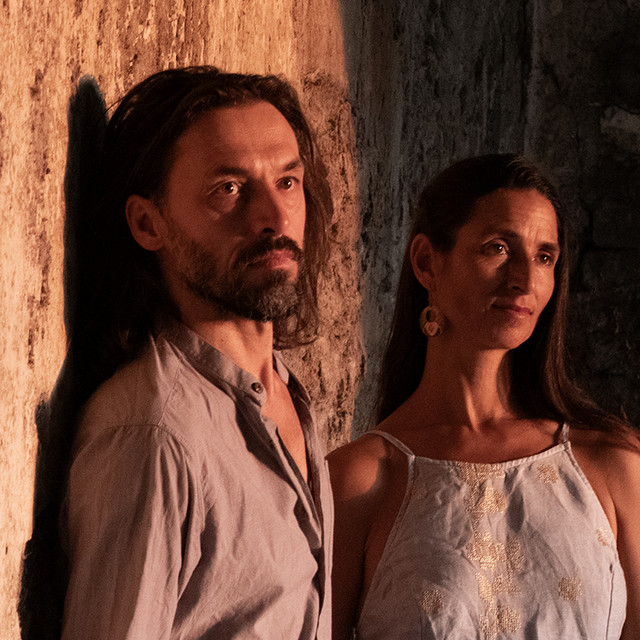
Mirabai Ceiba's "She" is a musical and visual meditation on a woman's inward journey toward self-discovery. The track captures a mother and woman carving out space to experience herself freely—moving through silence, nature, and solitude to access deeper creative and spiritual realms within. The song invites listeners, especially women, to remember and return to their own nurturing inner spaces where their wild, free spirit lives.
What Is "She" About?
"She" is Mirabai Ceiba's first single from their album The Quiet Hour, released in 2021. The song is not a narrative in the traditional sense but rather a poetic unfolding of an inner landscape. It follows the arc of a woman—specifically a mother—who pauses within her life to create space for herself. In that pause, she opens a door to experience herself freely, without the roles or identities that typically define her daily existence.
The journey the song documents is not one of external achievement or acquisition. Instead, it traces movement toward interior spaces of silence, stillness, and creative renewal. The protagonist of the song listens to the quiet, feels the call of the wind, and allows herself to be surrounded by silence. In this state of receptivity, she discovers that her nurturing, creative space—the well from which her wild, free spirit draws—is always available to her. She only needs to remember to enter it.
How Does the Music Video Visualize the Inner Journey?
Directed, filmed, and edited by Igor Nieto Joly with assistance from Alina Djamila Sieber, the music video uses landscape, light, and movement to externalize the internal process. The visual language mirrors the song's poetic tone: natural environments, dawn light, trees, wind, and the interplay of stillness and motion create a dreamlike aesthetic. The video doesn't illustrate the lyrics literally but rather holds space for the listener to project their own inner experience onto the imagery.
The cinematography emphasizes the theme of solitude as sacred. A woman moves through natural settings, sometimes still, sometimes in motion, as if the landscape itself is part of her interior journey. The visual treatment avoids sentimentality or melodrama—instead, it offers what the song calls "the beauty of no-time," a space outside ordinary temporal flow where renewal and remembrance become possible.
What Does "Reaching Out to the Dawn" Mean in the Lyrics?
The opening image—"She reaches out to the dawn / to see if its secrets will be revealed"—sets the tone for the entire work. Dawn is traditionally a symbol of beginning, of light emerging from darkness, of potential. In this context, the woman is in a posture of receptivity toward that potential. She is not commanding or grasping; she is reaching, which implies both vulnerability and openness.
The phrase "to see if its secrets will be revealed" suggests that she understands the dawn—and by extension, life itself—as holding secrets. These are not secrets to be discovered through intellectual effort but rather mysteries that unveil themselves to the receptive heart. The reaching gesture is an invitation: "Show me. Let me know you." This opening establishes the song's fundamental relationship to experience: listening, waiting, and allowing rather than pushing or controlling.
What Role Does Silence Play in the Song?
Silence appears twice in the first verse—"the quiet window" and "the silence like a thick breath." Both images treat silence not as absence but as presence. The quiet window "listens too," suggesting that stillness is not passive but participatory. The window becomes a companion in the listening. Similarly, silence is described as "like a thick breath"—a living, breathing substance that "surrounds her and she is full of it too."
This poetic treatment of silence reflects a spiritual understanding: that silence is not empty but full, not dead but alive, not isolating but connecting. When the woman is filled with silence, she is not diminished but enlarged. This inversion of how silence is typically experienced in busy, noise-filled modern life is central to the song's message. Silence is positioned as a doorway to fullness rather than a state of deprivation.
How Does the Song Address the Loss and Recovery of Self?
A pivotal moment in the lyrics reads: "As if forgetting who she was / or who she will be / the newness of this moment the freshness / in her eyes." The phrase "forgetting who she was" could suggest confusion or disorientation, but in this context it is liberation. The woman is shedding her biographical identity—the roles, expectations, and narratives that typically anchor selfhood.
In releasing that grip, she discovers "the newness of this moment." This newness is not a blank slate but a reorientation toward the present. She sees with "freshness in her eyes"—the eyes of someone awake to what is, rather than filtering experience through what she thinks she should see or how she thinks she should be. The song suggests that beneath the constructed self lies a more authentic, more alive presence. Access to that presence requires the paradoxical act of forgetting the self she has known.
What Is the Significance of the Creative Nurturing Space?
The song's climactic realization is that "her own nurturing creative space is always there, available." The woman's discovery is not that she needs to acquire something new but that something essential has been within her all along. She "only needs to enter it." This speaks to a common theme in contemplative traditions: the recognition that what we seek already dwells within us, and the spiritual work is one of remembrance rather than attainment.
For women especially, the song honors the capacity to nurture—and reframes it as rooted in a creative, spiritual space rather than mere obligation or caregiving function. This nurturing space is where the "wild free spirit" lives. By returning to it, a woman reconnects not with selflessness or sacrifice but with her own generative power and authentic aliveness. She becomes a source, not a servant.
Who Is the Song Dedicated To?
Mirabai Ceiba dedicates "She" to women, with the explicit intention to "remember to always reach out to their deep spaces within; those that nurture our wild free spirit." This is a call to spiritual and creative remembrance. In the context of modern life—where women often manage multiple roles, responsibilities, and expectations—the song's invitation to pause and access interior creative space takes on particular resonance.
The dedication is not sentimental or prescriptive. It does not tell women how to access their inner space or what they should find there. Instead, it affirms the existence of that space and invites women to treat its cultivation and visitation as essential, not optional—as a form of self-care that is simultaneously spiritual practice and creative necessity.
What Is the Artistic Context for This Release?
Mirabai Ceiba, the duo of Angelika Vee Kley and Markus Sieber, has built a body of work around sacred sound, mantra, and the intersection of world music traditions with contemplative spirituality. The release of "She" as the first single from The Quiet Hour signals a deepening of their exploration into interior space and the power of silence itself. The album title—The Quiet Hour—positions the entire project within this same orientation.
By releasing the song with an official music video across major streaming platforms, Mirabai Ceiba brings contemplative, spiritually-rooted music into the mainstream sphere while retaining its integrity and depth. The production credits reveal an international collaborative effort: direction by Igor Nieto Joly, color correction by Pavel Yudin in St. Petersburg, and production by Spirit Voyage Records. This professional, thoughtful approach honors both the artistic vision and the listeners who will encounter the work.
Where to Go From Here
Listen to "She" with full attention—not as background music but as an invitation to pause. Notice how the sound unfolds, how the lyrics land in your body, how the music video's imagery speaks to your own inner experience. If you are a woman, consider the prompt at the song's heart: When did you last enter your deep nurturing creative space? What prevents you from visiting there regularly? What happens when you do?
Explore the full album The Quiet Hour across Spotify, Apple Music, Deezer, and other platforms. Follow Mirabai Ceiba on social media (Facebook, Instagram, Twitter) and visit their website for further music, teachings, and events. The work of contemplative artists like Mirabai Ceiba serves as a mirror and compass: it reflects the possibility of a different relationship to time, silence, and selfhood, and it orients us back toward the interior dimensions that modern life so often asks us to ignore.


